

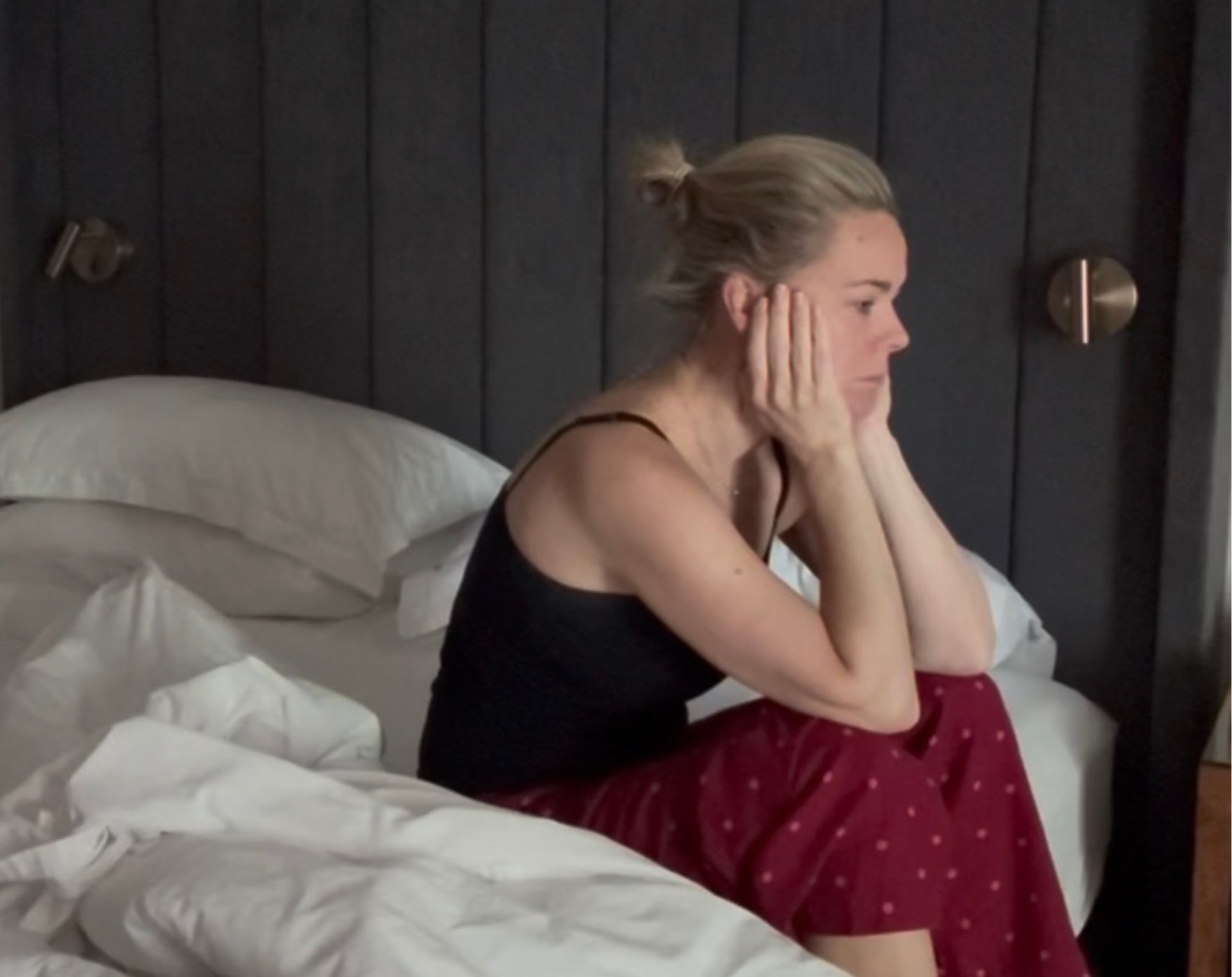
You’ve been running on empty all day long. You pushed through the morning, dragged yourself through the afternoon, and made it through dinner, the dishes and everyone else’s bedtime. And finally, this is your moment. You crawl into bed, pull up the covers, close your eyes… and you’re wide awake.
Maybe it’s the never-ending trips to the bathroom. Maybe it’s muscle spasms that won’t let up, or the glorious hot flashes. Or maybe it’s the hamster wheel of what-ifs cycling through your mind at 2am while everyone else in the house is asleep. Whatever it is, you just want sleep. And the place I want to start might surprise you, because it’s in the morning.

Apple Podcast | Spotify
Why Sleep With MS Is So Rarely Just About the Hours
This weekend the clocks fell back and we got an extra hour of sleep. On paper, what a gift. But if an extra hour fixed sleep, none of us would be tired.
When you’re living with MS, sleep problems usually come from a few different places: your bladder, spasms, a racing mind, and for many of us, perimenopause adding another layer with hot flashes, night sweats and those 3am wake-ups for no reason at all. And that racing mind spins even faster if you’re newly diagnosed, dealing with a new symptom or in the middle of a flare.
And then someone, very well-intended, says, “Oh, you just need a good night’s sleep.” If only it were that simple.
Ask “What’s Waking Me Up?” Instead of “Why Can’t I Sleep?”
I really like how Dr. Riley Bove, a neurologist at UCSF who works with women with MS going through menopause, approaches this. Instead of trying to sort every symptom into an “MS” bucket or a “perimenopause” bucket, she looks for the cause. Is it hot flashes waking you up? Your bladder? Anxiety and a racing mind? Each one has a different fix.
I’ll be honest with you. Generally speaking, I’m a good sleeper. There are really only a couple of things that still mess with my night. One is hormones: the night or two before my period tends to be interrupted. The other is sugar too close to bedtime. I know, that feels like such an old person thing to say. But it’s happened too many times to ignore. Everything is a choice and a trade-off, and for me, I’ll pass on the sugar so I can get a good night’s sleep.
Simple Fixes for Bathroom Trips, Hot Flashes and a Racing Mind
- Bathroom trips: stop fluids around 6 or 7pm and try double voiding, a tip from urologists. Go to the bathroom, do five minutes of your bedtime routine (brush your teeth, wash your face, get in your pajamas), then go one more time to empty your bladder completely. For more on staying hydrated without living in the bathroom, read How to Improve Hydration and Pee Less.
- Heat or hot flashes: cool the room down. Lighter blankets, lighter pajamas, and a fan if you need it.
- A racing mind: write the worries and to-dos down before bed so they’re out of your head and on paper. It sounds simple, but try it.
The Night My Heart Was Content
After I left the corporate world in 2014, and before I opened my nutrition coaching practice full-time, I went to culinary school in New York City. It was a fun season, and a very stressful one. I had just left a stable corporate career, my mom was in the final years of a decade-long battle with cancer, and I was 34, single and really wanting to start a family. I also didn’t know it yet, but I was starting to have symptoms of MS. I wouldn’t get the official diagnosis for another two years.
I was up almost every hour, every single night.
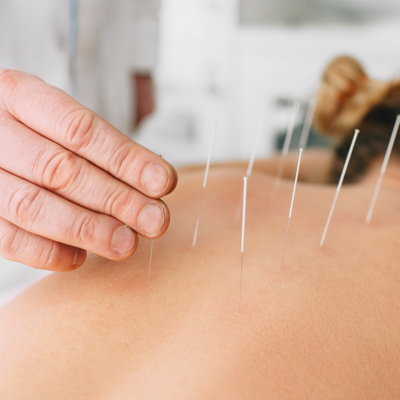
Then my sister came to visit and stayed the night, and I slept like a baby, almost straight through. When I told my acupuncturist, she didn’t skip a beat: “You slept because your heart was content because you were with your sister.”
It’s the sweetest thing. And it’s so eye-opening. The physical, mental and emotional parts of us are all connected. So if your nights are rough during a hard season, that makes sense, especially with a new diagnosis, a new symptom or a flare.
Why Better Sleep Starts in the Morning
A number of years ago I was at a conference, and someone shared that she was exhausted all day and couldn’t fall asleep at night. The speaker’s answer? Go outside first thing in the morning. I remember thinking… wait, what? Her problem is at night.
It actually makes perfect sense.
How Your Circadian Rhythm Affects Sleep With MS
We all have an internal clock, our circadian rhythm. A sleep researcher at Stanford describes it like the conductor of an orchestra, keeping your sleep, energy, hormones, metabolism and immune system on the same beat. And light is how that conductor knows what time it is.
Bright morning light tells your brain, “It’s morning, we’re up.” That sets the clock for the whole day, so later when it gets dark, your body knows it’s time to wind down. It also helps with the timing of cortisol. Cortisol gets a bad rap as the stress hormone, but in the morning it’s your get-up-and-go. You want it up in the morning and coming down at night, instead of dragging all day and then feeling wired at 11pm.
Bright light at night does the opposite. Yes, I’m looking at your phone, and mine. It tells your brain it’s still daytime and pushes back melatonin, the hormone that helps you feel sleepy.
Why Winter Makes Sleep With MS Harder
When the clocks fall back, the bigger change is the light. It’s darker in the morning and dark by the time you’re making dinner. Many of us end up with less morning light and more screen light at night, which is exactly backwards from what our bodies need. And even if you live somewhere that doesn’t change the clocks, your mornings are still getting darker.
Here’s how I think about it: in the summer, the light finds you. In the winter, you have to go find it.
Your sleep needs also change with the seasons. A lot of us need more sleep in winter. Same with seasons of life, and living with a chronic illness is one of them. If you need more sleep right now, you’re not lazy. Give yourself some grace.
And a bonus for my heat-sensitive MS sisters: winter is actually an easier time to get outside in the morning, without worrying about the heat. (If heat is a big one for you, here’s the real story behind MS heat sensitivity.)
How to Get Morning Light With MS (Without Adding One More Thing)
- Timing: within the first hour of waking, or once the sun comes up.
- Outside is best, even on a cloudy day. Aim for 10 to 15 minutes, and take the sunglasses off. Nobody is staring at the sun. Just let the daylight reach your eyes.
- Can’t get outside? Sit by a window, ideally east-facing. Have breakfast or a cup of tea there, or do your hair and makeup by the window.
- Long dark stretch? A light therapy lamp can help fill the gap.
My morning light usually comes from preschool drop-off. We walk to the car, and when we arrive a little early, we stand outside and chat with the other moms and kids. Even those 10 or 15 minutes can make a difference.
The trick that makes it stick: don’t make it a new thing. Stack it on something you already do. Your breakfast, the drive with the sunroof open, the dog walk.
Your One Small Step
Tomorrow morning, within an hour of waking, get 10 minutes of daylight. Outside if you can, by a window if you can’t. You’re not overhauling your bedtime or buying anything. You’re just letting your brain know it’s morning.
Bonus if you want it: keep the same wake-up time all week, even with the clocks changing. And if 10 minutes feels like too much, ask yourself, “What’s the smallest version I can do?” Five minutes is better than none.
I’d love to hear from you. Send me a DM on Instagram at @alenebrennan.ms and tell me what’s waking you up at night, and where your morning light spot is going to be this week.
Start With Just One Habit
MS has its own biological clock, which means the sooner you start, the more power you have to influence your future. If you’re not sure where to begin, join my free masterclass, Where to Start With MS Nutrition and Lifestyle (When You’re Too Tired to Overhaul Everything).
Save your seat here
Related Posts For Sleep + MS Fatigue
- 5 Simple Habits to Improve Sleep with MS (S9E2)
- How to Ease MS Fatigue During the Holidays (Without Burning Out) (S8E6)
- 3 Simple MS Tricks for Fatigue, Bladder Issues and Heat Sensitivity (S12E4)
- How to Improve Hydration and Pee Less (S5E4)
- Ambition Built to Last: How to Stay Ambitious With MS Fatigue (S12E1)
- How I Knew I Had Multiple Sclerosis
Full Podcast Transcript
Read the full transcript here:
S12E6 Better Sleep Starts in the Morning (Even With MS)_Transcript
[00:00:00] You've been running on E all day long. You pushed through the morning, you dragged yourself through the afternoon, you made it through dinner, and the dishes, and everyone else's bedtime. And finally, finally, this is your moment. You crawl into bed, you pull up the covers, you close your eyes, and you're wide awake.
Maybe it's the never-ending trips to the bathroom. Up once, up twice, up again. Or maybe it's the muscle spasms that just won't let up. Maybe it's the glorious hot flashes. Covers off, covers back on, covers off again. Or maybe it's the hamster wheel, the what-ifs, the worst-case scenarios cycling through your mind at 2:00 AM while everyone else in your house is fast asleep.
Whatever it is, you just want sleep, and you'd love some guidance on how to get more of it. So that's what we're doing today, and the place I wanna start might surprise you, 'cause it's not at night, it's in the morning. And before we get started, I wanna [00:01:00] invite you to something special. Living with MS can feel overwhelming, but one habit can shift everything.
That's what I'll show you inside my free webinar, How to Help Slow MS Progression, Starting With Just One Habit. Think of it as your first step towards more energy, confidence, and hope. Save your seat at alenebrennan.com/webinar. Welcome to my MS podcast, where women with MS learn how to slow progression and live a life they love.
I'm Alene Brennan, your MS sister, and a practitioner who knows the science and the reality of living this too. Each week, I share simple, science-backed habits to boost your energy, stay consistent, and feel like yourself again. Because MS may be a part of your story, but it doesn't get to write the ending.
Okay, my [00:02:00] friends, let's talk about sleep. So this weekend, if you live somewhere that does daylight savings time, the clock fell back and we all got an extra hour of sleep. On paper, what a gift, right? An extra hour of sleep. I'll take it all day, every day. But let's be honest, if an extra hour on the clock fixed sleep, none of us would be tired.
And when you're living with MS, sleep is so rarely just about the hours. Because like I said at the beginning, it's the bladder, it's the spasms, it's the hamster wheel, and that hamster wheel spins even faster if you are newly diagnosed or just got a new symptom or you're in the middle of a flare because your brain is trying to solve things that can't be solved at 2:00 AM.
And then perimenopause comes along and adds a whole nother layer. The hot flashes, the night sweats, [00:03:00] waking up at 3:00 AM wide awake for absolutely no reason And then the worst part, someone like I'm sure a very well-intended person says, "Oh, you just need a good night's sleep." Like nails down a chalkboard, right?
Like if it were only that simple. Here's something I really like from Dr. Riley Bove, a neurologist at UCSF who works with women with MS going through menopause. When women ask her, "Is this MS or is this perimenopause?" She doesn't try to sort it into one bucket or another. She looks for the-- like taking sleep, for example.
She would say, "Is it hot flashes waking you up? Your bladder? Anxiety and a racing mind?" Because each one has a different fix. So I know it's so tempting to wanna know, like, is this because of MS or is this because of perimenopause? [00:04:00] But she encourages us to not look at it from such a siloed approach.
Instead of asking, "Why can't I sleep?" Start asking, "What is waking me up?" And I'll be honest with you, generally speaking, I am a good sleeper. At this point, there are really only a couple things that mess with my night's sleep. One is hormones. The night or two before my period tends to be a pretty interrupted night's sleep.
The other thing is sugar. Sugar too close to bedtime, which makes me feel so old saying it out loud because that feels like such an old person thing to say, but it's happened way too many times for me to ignore or deny it. And I didn't do it often anyway, maybe on the weekends here and there, but everything is a choice and a trade-off.
And for me, I will pass on sugar thanks so that I can get a good night's sleep. If it's your bladder that's affecting your sleep, try stopping your fluids around six or seven at [00:05:00] night and double voiding, which is a tip that comes from a urologist. Basically, going to the bathroom and then doing something else for five minutes, like brushing your teeth, washing your face, getting in your jams, whatever, and then go to the bathroom one more time, ideally like five minutes after you last went, to completely empty your bladder.
That concept of double voiding has been really effective for people who wake up in the middle of the night to go to the bathroom Or if it's heat or high flashes, cool the room down, like lighter blankets, lighter pajamas, a fan if you need it. And if it's your mind, write the worries and the to-dos down before you go to bed, like get it out on paper, out of your head.
And I know that that sounds like oversimplistic, but try it. It can make a big difference. And let me tell you a little story about a racing mind, because this memory still sticks with me so many years later. [00:06:00] So after I left the corporate world in 2014, and before I opened my nutrition coaching practice full-time, I went to culinary school in New York City, and it was absolutely a fun season.
I mean, you're living in Manhattan, but also it was a very stressful one as well. I just made a major life change, leaving a very stable and successful corporate career to venture out on my own for this passion that I had had my entire life. And also, my mom was in the final years of a decade-long battle with cancer.
I also was 34 and single and really wanting to be married and start a family. You know that kind of season where you're like, "Where is my life going?" And I didn't know it at the time, but I also was starting to have symptoms of MS, even though I didn't get the official diagnosis for another two [00:07:00] years. So there was so much going on, and so much felt out of my control.
And I was up almost every hour, every single night. Then my sister came to visit me and stayed the night, and I slept like a baby, like almost straight through the entire night. And I was going to acupuncture at the time, and when I told her about this experience, I was like, "How did I have all of those sleepless nights, and then this one night I almost sleep through the entire night?
Like, what? How did that happen?" And without, like, even skipping a beat, she looks at me and she says, "Oh, you slept because your heart was content because you were with your sister." And I was like, "I'm sorry, what?" Like, that's the sweetest thing I think I could possibly imagine But also really [00:08:00] eye-opening.
Like, our bodies are wild. The physical, mental, and emotional, it's all connected. So if your nights are rough during a hard season, that makes sense, especially if you are dealing with a new diagnosis or a new symptom or a new flare. Those seasons of life are not just about physical symptoms. There is a huge mental and emotional load that you carry as well.
Your body is carrying a lot. So I know I just, like, rapid-fired a whole list of nighttime tools, but I wanna talk about the one that happens in the morning. So I was at a conference a number of years ago, and during one of the sessions, someone shared that she was exhausted all day and couldn't fall asleep at night.
And I'm sitting there nodding 'cause I'm like, "Yep, been there." And I know that so many of us can relate to that experience. But listen to the answer she [00:09:00] got from the speaker. "Go outside first thing in the morning and look at the sun." And I remember thinking like, "Wait a minute, what?" She can't sleep at night, and your answer is in the morning.
It honestly sounded ridiculous, and I could see the look on her face, too, like, "Are you serious?" But it actually makes perfect sense because we all have an internal clock, your circadian rhythm. A sleep researcher at Stanford describes it like a conductor of an orchestra, keeping all the different systems in your body playing on the same beat.
Your sleep, your energy, your hormones, your, your metabolism, your immune system. And when that conductor is off, everything else feels a little off. And light is how that conductor knows what time it is. So when you get bright light in the morning, it's sending a clear signal to your brain, "It's morning.
We're up." And that sets the clock for the [00:10:00] whole day, which means later when it gets dark, your body actually knows it's time to start winding down This all helps with timing of cortisol. And I know cortisol gets a bad rap. It's the stress hormone. But in the morning, cortisol is actually your get up and go.
You want it to be up in the morning and coming down at night, not the other way around, where you're dragging all day long, and then you're wired at 11:00 PM, right? And then the flip side, bright lights at night. Yes, I'm looking at your phone and mine. It does the opposite. It tells your brain it's still daytime and pushes back melatonin, the hormone that helps you feel sleepy.
I'm guilty of scrolling at night too, and I notice that even when I fall asleep at a normal time, I don't wake up feeling as rested if I've been on my phone the night before. So the sleep you get at night [00:11:00] starts with the light you get in the morning. And this is why I wanted to talk about it this week specifically because when the clocks fall back, yes, you get an extra hour of sleep, but the bigger change is the light.
It's darker in the morning. It's darker by the time you're making dinner. And for a lot of us, we're getting less light in the morning and more screen time at night, which is exactly backwards from what your body needs. And even if you live somewhere that doesn't change the clocks, your mornings are still getting darker this time of year.
Here's how I want you to think of it. In the summer, the light finds you. In the winter, you have to go find the light. In the summer, you're outside. The sun is up early. You're getting light without even trying. In the winter, you can go from your bed to your kitchen to your car to your desk and barely see real daylight until lunch, if at all.
And your sleep needs change with the [00:12:00] seasons. A lot of us need less sleep in the summer and more in the winter. Same with the seasons of life you're in. Little kids, a demanding job, and of course, living with a chronic illness You need more rest. So if you're feeling like you need more sleep right now, you are not lazy.
Your body is just demanding more sleep in this season. Give yourself some grace there. And a little bonus for my heat-sensitive MS sisters, winter is an easier time to get outside because we don't have to worry about the heat. I get it. I have a heat sensitivity too, and getting outside in the summertime can feel a little daunting sometimes.
But you don't have to worry about that in the winter. Okay, so let's talk about what this actually looks like in your real life because I know you don't need just one more thing added to your list of coulds or should be doing to better manage MS. So ideally, you're getting some [00:13:00] daylight within the first hour of waking up, or if you're up before the sun, once the sun comes up.
Outside is best. Even on a cloudy day, the light outside is so much brighter than anything inside your house. 10, 15 minutes, great goal. And take the sunglasses off for this part. Remember that conference story I told you? The speaker actually said, "Look at the sun." Nobody is staring at the sun. Take the sunglasses off.
Let that sunshine reach your eyes. If you can't get outside, I get it. Some mornings it's just not happening for a variety of reasons. So if you can't, try sitting by a window, ideally an east-facing window where the morning sun comes in. You could have your breakfast there, have a cup of tea, or maybe you do your hair and makeup by a window if that's an option.
It doesn't need to be complicated. Again, you'll often hear me say, "If this were simple, what would it look like?" How could you [00:14:00] make getting a little bit more morning light easier for you? And if you're in a long, dark, rainy stretch, a light therapy lamp can help you fill that gap. My morning sunshine typically comes taking my daughter to preschool each morning.
We're walking to the car, we have the car drive there, and then I do arrive a little bit early, and she and I will stand outside. We're either talking to, um, other moms and kids or playing on the front yard there and just having our own fun. But I know even those 10 or 15 minutes can make a big difference.
And here's a little trick that makes it stick. Don't make it a new thing. Stack it on something you're already doing. Again, you have breakfast every day, so can you do it by a window? Or if you have the option, if you're driving in the car, can you open the sunroof? Or you may already naturally be getting it if you're taking a dog for a walk or a baby for a walk, right?[00:15:00]
There are some ways that you can tuck this in without it having to be a separate habit. So here's your one small step. Tomorrow morning, within the first hour of waking up, get 10 minutes of daylight. Go outside if you can, or sit by a window if you can't. That's it. You are not overhauling your bedtime.
You are not doing an hour-long nighttime routine. You're not buying anything. You're just letting your brain know it's morning. And if you want a bonus, try keeping the same wake-up time. Even with the clocks changing, consistency can be a big part of what helps that internal clock settle. And if 10 minutes feels like too much, ask yourself, "What is the smallest version that I can do?"
Because five minutes is better than none. Okay, my friends, I would love to hear from you on this one. Send me a DM on Instagram. What's waking you up at night? Is it your bladder, hot flash, your mind, or something else? And [00:16:00] where's your morning light spot gonna be this week? All the links of today's episode are over on the blog at alenebrennan.com/blog.
And remember, so many of the topics that we talk about here on the podcast are listener-requested. So if there's something that you want me to talk about, send me a DM or an email. I would love to hear from you. All right, my friends, take care. Have a great day. We'll talk soon. And that's it for today's episode of my MS podcast.
I hope you're walking away with one small step you can put into practice today, because that is how real change happens. And remember, MS has its own biological clock, which means the sooner you start, the more power you have to influence your future. The best time to begin is now. That's why I created my free webinar, How to Help Slow MS Progression, [00:17:00] starting with just one habit today.
Grab your spot at alenebrennan.com/webinar. See you there.






+ show Comments
- Hide Comments
add a comment